Written, Interviewed, Filmed by Caela Collins
Unbeknownst to many and known to some, Connecticut was coined as “The Land of Steady Habits,” which first appeared in the 1800s. That moniker coincidentally has as much breadth as the biodiversity within Hawai’i, the most biologically diverse regions on the planet. The “steady habits” of Connecticut have proven over centuries to be quite unsteady due to our state’s capacity for change, which ironically is the steadiest feature of our inverted saucepan-shaped land. Following a steady journalism beat, ECCT’s Digital Storytelling nomadically hunts down stories within the realms of our Northeastern nutmeg sector. However, what is the “Land of Steady Habits” without habitual change?
In early August, only days prior to the wildfire devastation in Maui, I visited The Episcopal Diocese of Hawai’i to conduct a story on the rich history of the isolated oceanic archipelago’s diocese. With a heavy heart, I craft a story from a different angle that allows us to not only learn the history of the great island(s) but also highlight how we can aide our Hawaiian siblings as we learn of their culture.
The Hawai’i Islands
Hawai’i is a archipelago, group of islands, that consists of eight major islands. From left to right:
- Niihau: ‘The Forbidden Island’ is the most untouched of all the inhabited Hawaiian islands with under 200 native Hawaiian residents who preserve the Hawaiian language and culture with their dedication to living the lifestyle of their ancestors.
- Kauai: ‘The Garden Island’ known for its lush forests and waterfalls and being the greenest of the Hawaiian islands due to its emerald tropical landscapes.
- Oahu: ‘The Gathering Place’ which is the most visited island due to world famous Waikiki beach, historic Pearl Harbor, and state capital, Honolulu, where The Diocese of Hawai’i resides.
- Molokai: ‘The Friendly Isle’ known for its intentional quaintness in a rural setting to preserve a slow-paced atmosphere. The people harness Aloha spirit which is a way of life valued by Hawaiians to treat each person with warmth and respect as their ancestors did. It’s the spirit of coordinating both mind and heart.
- Lanai: ‘The Pineapple Isle’ is its nickname due to the island’s Dole pineapple plantation origins; once producing 75% of the world’s exported pineapples.
- Maui: ‘The Valley Isle’ due to its unique geography divided by two mountain ranges—the Haleakala and West Maui Mountains. The island’s interior is less than 200 ft above sea level, sandwiched between the two major mountain ranges, which feels as though you’re traveling through one massive valley.
- Kahoolawe: ‘The Target Isle’ used as a bombing range by the U.S. military for testing and training.
- Island of Hawai’i: ‘The Big Island’ because it is the largest island in the U.S. over 4,000 square miles and can fit 63% of the Hawaiian archipelago’s combined landmass.
The Hawai’i Diocese consists of 35 worshipping communities on five islands. Watch below to learn about the geographical layout of the eight major islands that make up Hawai’i.
A Sign of God’s Grace
Here at ECCT we have been exploring diversified sacred images through Iconography. The piece above/behind the altar showcases the Hawaiian Madonna and child which was painted for Holy Innocents Episcopal Church, Lahaina, HI in the 1940s. “The unthinkable happened when wildfires ravaged the island of Maui, tearing through Lahaina town, and leaving death and destruction in its wake. Holy Innocents Episcopal Church was one of hundreds of structures that succumbed to the fire.” In the midst of wildfire smoke, the same iconographic image, Hawaiian Madonna and child, that stood at the altar was also used for the church’s welcome sign and by the grace of God, that welcome sign is still intact in the front yard! This is a testament that even in a spiritual season of winter, a waiting season with darkened days faced with the cold reality of loss or change, is also the time when God is doing something powerful underground which we cannot see. That welcome sign still standing is a visual and tangible representation that God is forever present even in times of refuge. It affirms that a church is so much more than four walls or a building at all; a church is a home where your heart rests in the Lord through all spiritual seasons.


Prayer for Maui

| Almighty God, who is our strength and our refuge; be with those who are besieged by fire, guide those who evacuate so that they may find care and comfort in a safe place; protect their homes and their pets, their neighbors and their friends, so that they may return home to a loving community. We ask this in the name of Jesus your son, who abides with you and with the Holy Spirit. Amen. O God, whose love encircles us; sustain those who respond when wildfires roar, keep them safe from harm and hold them in your sheltering embrace so that they may complete these burdensome tasks, return home to their families, and keep the lives and homes of all they protect safe from harm, in the loving name of Jesus, who gave his life for all. Amen. Loving God, our strength in times of despair, be with all those who have lost their homes to wildfire, comfort them in their distress, strengthen them for the journey ahead, and sustain them with your loving embrace, that they may find a sense of home once again. We ask this in the name of your son Jesus Christ, who heals the sick and restores the lost. Amen. |
How to Help:
- The Episcopal Diocese of Hawaiʻi is coordinating immediate diocesan relief efforts to the Lahaina fire disaster through the Diocese’s A CUP OF COLD WATER (ACCW) (a separately incorporated subsidiary of the Diocese that serves the houseless on Maui).
- You can make an online donation through the Bishop’s Pastoral Fund HERE and also through the website of the Episcopal Diocese of Hawaiʻi (the funds will be gathered and sent to ACCW).
- You may also mail checks directly to: A Cup of Cold Water, 2140 Main St., Wailuku, HI 96793
- Pray A PRAYER FOR THOSE FACING WILDFIRES.
Hawai’i: Where Culture & Religion Collide
“We have a different cultural and ecclesial history and understanding than often happens in the Episcopal Church.” -The Rt. Rev. Robert L. Fitzpatrick
The diocese of Hawai’i is unusual due to it being brought over by Royal Hawaiian invitation. Cultural heritage is a major pillar for Pacific Islanders which makes their embrace around Christianity different. They immerse their own ways of worship that reflect their cultural symbols and heritage at large within the Christian faith. For example, November 28th is the Feast of the Holy Sovereigns, King Kamehameha IV and Queen Emma of Hawai’i who in 1862 asked Queen Victoria to send a bishop. Much like Connecticut, The Land of Steady Habits, Hawai’i too has a strong tie to multiplicity in it’s efforts of balance between becoming and being. There’s a deep understanding of cultural identity and how it holds a sacred place both within the past and future. Everything that is historical will undergo constant transformation.

Mai Poina ‘Oe Ia‘u
(Remember Me)
Painting by: Leohone Magno
“Queen Lili‘uokalani was raised in the Congregational Church and was the musician for one of their main and historic churches in Honolulu. Throughout her earlier years, however, she was connected with just about every denomination, including the Mormons. Most of the Ali‘i, certainly most of her Mo‘i predecessors since King Kamehameha IV and Queen Emma founded what it now the Episcopal Diocese of Hawai‘i, had been members of our Church/generally at the Cathedral.
At the time of the armed overthrow by US businessmen backed by US Marines and her subsequent trial for treason and imprisonment (first at ‘Iolani Palace, then moved to Washington Place, next to the Cathedral and St. Andrew’s Priory School), she wrote with heartbreak over how all of the different denominations turned their back on her; all but our Church/Denomination.
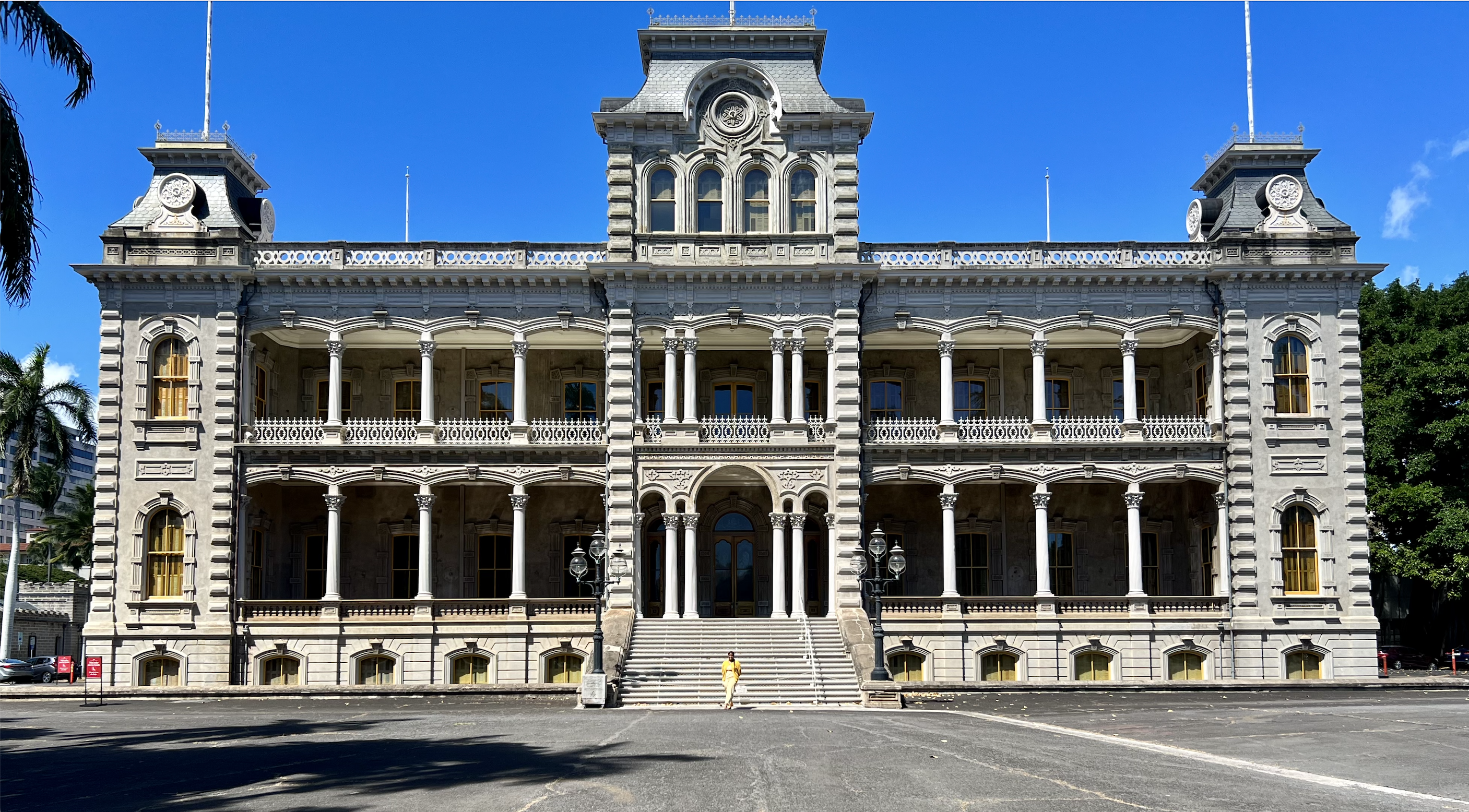
Two of “the English Nuns” at the priory gifted her with a prayer book the same month that the “Territorial Government” was proclaimed, and she mentioned the book being a source of solace in her imprisonment. The bishop also continued to visit her, which she mentioned was a source for her of information about what was happening outside of her house arrest.
At Washington Place, stories abound of her sneaking through the fence to spend time with the nuns at the priory, and she was baptized/confirmed at the cathedral and spent most of the rest of her life heavily involved as a member there (her signature appears on things as simple and otherwise everyday as altar guild reports).“
- Historical Account Provided by The Rev. Cn. Sandy Graham, Canon to the Bishop
