From June 7-June 14, 2025, members from the Episcopal Church in Connecticut went on a pilgrimage to Iona, Scotland. The pilgrimage was 30+ members strong and was offered through Earth & Soul and Hartford International University for Religion & Peace. Participants spent a week on the island where St. Columba first brought Christianity to Scotland in 563 CE. Throughout the week, they learned from the theologian John Philip Newell and spent time walking, writing, photographing, and spending time in deep conversation with one another. The following are reflections, in word and visual, of how they encountered the holy in the earth, sky, and sea of Iona.
All photos were taken by John Pearson, St. Matthew’s (Wilton).
A Pilgrimage to Remember
The Rev. Dr. Linda Spiers, Interim Supply Priest, St. Francis (Stamford)

“A Gaelic saying meaning those who come to Iona will come, not once, but three times”—the English translation of Gaelic words found on Iona Abbey’s entry wall to the cloister welcome one back or give hope for another visit to come. I don’t remember noticing those words during my first visit to Iona in 2022, and I rejoice in seeing them this time. Will there be a third visit for me? The holy isle of Iona, a small island in the Inner Hebrides and off the western coast of Scotland, captures the whole of one’s self—the mind, the body, the spirit, the senses. It’s magical and is known as a “thin place where only tissue paper separates the material from the spiritual” according to founder of the Iona Community George MacLeod—more words on the Abbey cloister’s entry wall.
The Abbey’s words of worship invited us into a simplicity of life, service for justice and peace, prayers for healing of our world and its peoples, care of creation, and commitment to be Gospel people. Our daily contemplative prayer with leader John Philip Newell guided us to the welcome of each new day in silence. Newell’s morning lectures opened doors into Celtic theologians.
People welcomed us. The sea, the wind, and the sky welcomed us with all sorts of birds raising their voices of welcome. Unnumbered sheep and lambs and goats watched and gently allowed us to share their grazing land. And so, the earth welcomed us onto exquisite hikes. A modern translation of Rublev’s icon of Abraham and Sarah’s three visitors had a prominent place in front of the Abbey’s altar and reminded us of Iona’s open arms for all sorts of pilgrims today. Magnificent flowers along our walking pathways welcomed us with their blossoms’ beauty—some growing in lovingly tended gardens and others popping out of ancient stone.
A new discovery came home with me—not only is Iona a thin place, it also teaches us to look for other thin places.
What Brought You to Iona?
Cathy Rowe, Trinity Episcopal Church (Hartford)

One of the first questions we were asked to contemplate when we arrived on the island was: “What brought you to Iona?” I responded with the same answer I had during meetings with fellow pilgrims leading up to the pilgrimage: “I joined the trip at the invitation of a dear friend who had been to Iona before.” It took me until about midway through the week to realize that I had been called to Iona by the Holy Spirit. Little by little, the island and the teachings of John Philip Newell (JP) chipped away at the tough exterior I had carried to Iona with me.
Our little band of 30+ pilgrims who traveled with the Hartford International University group blended with the pilgrims that came independently from us. We made friendships and shared dreams, concerns, and hopes for this beautiful cosmic ball we call earth.
Surprisingly, we learned as much from sharing our stories with other pilgrims as we did from the lectures of JP. I believe JP would consider that a sign of a successful pilgrimage.
I saw many beautiful sights including the Abbey of Iona, The Chapel at the Bishops House (home of the Episcopal Church in Scotland), St. Columba Bay, and many more. I will carry the beauty of the island and its “Cathedral of Earth, Sea and Sky” with me as long as I live.
For One Glorious Week
Sarah Kieffer, St. John’s Episcopal Church (West Hartford)

The word “pilgrimage” aptly describes the journey to Iona. Our individual trips to Glasgow and our collective travel together from there to Iona certainly felt like a journey to a sacred place. Pilgrimages often offer the opportunity to meet new kindred friends of Spirit, and, indeed, that fortuitously happened. But, in addition, once on the island of Iona, the experience for me took on an extra aspect, a delicious feeling of retreat from the world at large.
This was my second trip to Iona. I knew after my first trip in 2017 that I would be coming back to the Great Cathedral. To the sound of birds, of ocean waves, of chanting and of silence. To the visual landscape of coast, of hills, of ancient buildings, and of sheep. To the panoramic flow of light from dawn to day to dusk and to night. To the soothing peace of this precious island.
For one glorious week, we had the contemplative opportunity to go inward within self and the communal opportunity to explore spiritual community. The daily offering of a morning routine included an early morning guided meditation by John Phillip Newell (JP) and his wife Ali Newell, an Abbey service after breakfast, and a two-hour lecture by JP with engaging activity breaks of spiritual practice by Ali. This robust morning routine then segued into an afternoon of individual free choice. Each program participant was free to forge her or his own afternoons however it suited them. The menu of afternoon activities included rest, reading, writing, personal contemplation, exercise, and/or exploration of the island. Whatever the combination chosen, it was a win for spiritual refreshment and development. Dinner was a joyous celebration with opportunities to build community. My favorite activities after dinner were the evening service at the Abbey or a sunset walk.
Out of My Comfort Zone
Sharon Ely Pearson, St. Matthew’s (Wilton)
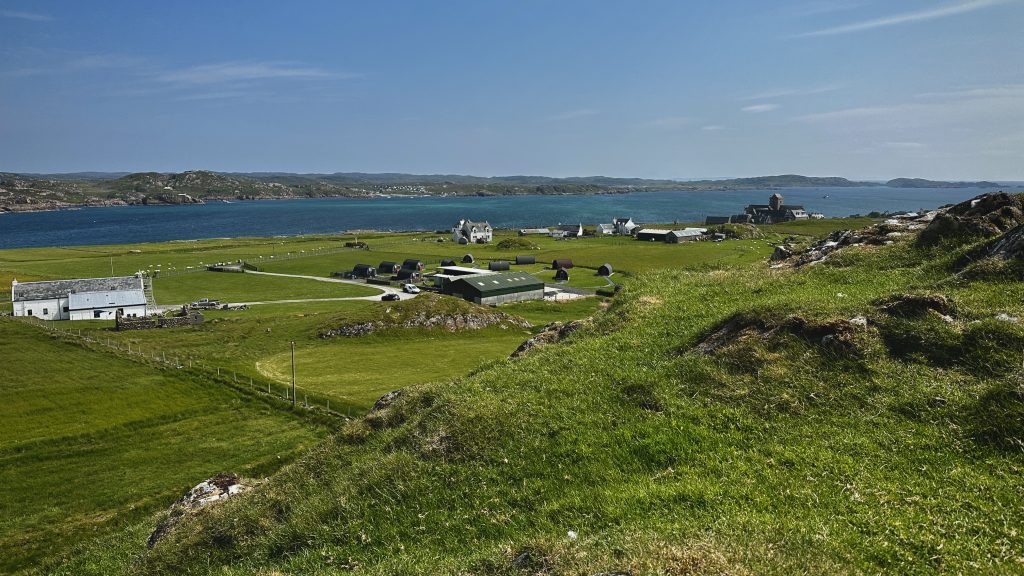
For me, my pilgrimage challenge was an afternoon “pilgrimage walk” of 9 miles, following winding sheep paths led by John Philip Newell (JP) across the island. Walking sticks in hand, a small band of us left the hotel after lunch, following the dirt road and crossing the sheep-filled golf course (yes, Scotland = golf) to wend our way up craggy paths, over hills and rocks, and through bogs until reaching the rock-strewn beach of St. Columba’s Bay. Stopping along the way from time to time, JP would ask, “What do you need to let go of? For yourself? Those close to you? The wider community?” (These themes of micro, meso, and macro parts introspection were repeated in various ways throughout the week). We searched for stones that “called to us”—only to throw them back to the sea with a prayer for healing. I also pocketed many as a remembrance of the moment.
The real trial began for me as we returned through the golf course and hiked past Bay at the Back of the Ocean that faces the Atlantic. Our next “walk” was to go up into the hills leading to the highest point on the Isle of Iona – Dùn Ì at 331 feet above sea level. “Dun” is Gaelic for hill, and “I” is an older name for Iona, so Dùn Ì means “The Hill of Iona.” It was here that an Iron Age hill fort once protected the island from pre-Viking marauders.
To reach Dùn Ì we crossed over stiles (to keep the sheep in), through bogs (the grass and moss were feet deep as we had had a full day of rain the day before), and mounds of vegetation. We stopped for a meditation at the Hermit’s Cell, ancient ruins of a stone circle that perhaps housed St. Columba or other monks. Toward the center of the island, (Iona is only 1.5 miles wide and 3 miles long) we could see our destination in the distance—it seemed so far and so tall. I was part a small band of “mature” women in the group; they encouraged me all along the way with “you can do it” as I encouraged them in return. After all, we had passed the point of no return.
Reaching the top of Dùn Ì, I was met by a vista of 350-degrees: green fields, blue ocean, white sand beaches, and the ancient stone Abbey below us. Plus, there were lots of high-fives between us women and JP whispering to me with a smile, “Well done Sharon.” Near the top was a rock pool called Tobar na h-Aoise, known as the “Well of Age” or “Wishing Well,” where pilgrims traditionally seek new beginnings. We bent over to splash water on our eyes, ears, and lips with a prayer. As I descended Dùn Ì with the other pilgrims, we found ourselves on the other side of the island on a road where John was waiting for me. It was a short walk back to the Abbey and our hotel. A test of endurance for me conquered in a 9-mile “walk” up a “hill” which felt like a mountain.
A Place for Prayers
Sarah Louise Woodford, Canon for Communications & Media

Some of you may know that Iona is a place of holy creativity. The Book of Kells was illuminated here and the modern-day Wild Goose Publications prints prayers, poetry, music, and books that combine the natural and sacred beauty of this tiny island where Christianity first came to Scotland.
I began my mornings and ended my days (it was still sunny at 10:30 PM!) often writing on a bench in the shadow of Iona Abbey. The wind, the cerulean-amethyst colored waves of Iona Sound, and the calls of hooded crows nesting in the abbey’s stone gutters, were my constant companions. Iona drew prayers out of me, materializing from the end of the stylus to the smooth screen of my tablet. My favorite prayer I turned into a prayer card, which I look forward to giving to you upon our next encounter (if you like):
A Prayer from Iona
God whose beauty opens daily in the blooming of a rose, remind us of our constant renewal in your love. Hold us in hope as an abbey holds those seeking shelter in the midst of a storm. Amen.