Poem: “Likeness”

Poem: “Likeness”


A Poem Written By: Caela Collins

Likeness

A poem about the likeness between trees and humans by Caela Collins. Earth Day 2023

Like Trunks We stand tall and Like their stumps, sometimes we fall short.
In moments of despair, we bow our heads deep down into our shoulder blades and weep Like Willows.

Like blowing leaves, We shiver in the frigid wind when it grazes our epidermis.
We stretch to the morning sun Like broken seeds.

Like roots, We constantly thirst for more.
And Like bark, our palms hold lines.
Sometimes we forget how much trees are like humans.

We don’t stop to listen to their jokes or join in on the laughter & applause from the rustling leaves.
We don’t pay attention to the polite waves from their swaying branches in our windows.
We look at them every day but don’t truly see them for who they are.

How lonely it must be for the Trees.  

Unlike Trees, we hide from the rain, which storms under the clouds and within our hearts.
We don’t recognize brokenness as an opportunity for a new life like the sprout from a seedling.

Unlike leaves, we don’t go where the wind takes us.
We’d rather plaster on fake smiles and oversaturate ourselves with superficial needs than hold on tight to what naturally nourishes our soul.

And like stained wood flooring or beautified headboards on that home decoration channel, we are disconnected from our roots.
Sometimes we forget how much humans can learn from trees.

How Lonely it must be for the Humans.

In the Midst of Mist

Interviewed & Written By: Caela Collins

Fear, a shadow we know all to well.
Something that comes knocking at our door

Regardless of any socially constructed differentiation that would coin any human as “other.”


Fear has no preference or boundaries for human territory.
It is inevitable in all of our lives;
Taking the form of layered mist, concealing the road ahead.


How far can you truly run to safe haven, with shadows attached to your heels?
Running: A survival instinct.
Running puts distance between you and the threat
And in the same stride, running also puts distance between you and the confident gift of faith.

Allow fear to knock on your door.
Give fear a seat at your dinner table.
Look fear in the eyes even if your heart, hands, and voice tremble.
And embrace a sacred space with fear to have a brave conversation.
After all, this is your home.


How close can you truly come home to yourself, while shining your light against the shadows?
Faith: A spiritual instinct.
Having faith in the same God who birthed galaxies, blessed you with the light of hope in the dark depths of a whale’s abdomen, quiet a lion’s roar to conceal it’s snarling fangs, crush venom by the fleshed heel, make giants tumble down to your toes, and effortlessly built the air you breathe.

The very air ironically prickling your nose hairs as you run.
Even though your stomach churns and legs quiver,
You hear God’s words: “Turn back my child.”
Fear is inevitable in all of our lives but Faith is too.


Allow fear to bang against your door.
Tell fear to have a seat at your dinner table.
Hold fear deep in your gaze.
And take up space where fear has no option but to have a brave conversation.
After all, this is your home.


What matters is your execution in how you address
the shadow of fear.
Who are you when fear is watching?
How faithful are you in the midst of mist?

-Poem for National Poetry Month: In the Midst of Mist By: Caela Collins


I came across a post today on Instagram that said “Let go of what you think it must look like.” How often do we lean on our on understanding? How quickly do we take a leap of faith over sprinting for the hills when fear is on our heels? If you’re being honest you may be leaning more towards less times than you’d like to admit. I had the opportunity to discuss what it’s truly like to be faithfully brave in the midst of mist with my coworkers and friends, Alison Hollo and Roxy Flores as they detailed their experience with Autism which was described as never truly knowing what’s next but having faith that everything will be okay even in the unknowing.

These women have inspired me and taught me so many lessons just in the 30 minutes we had to talk. They both have a commonality within the month of April: Autism Awareness Month. Alison, Senior Administrator, Office of the Episcopate and Roxy, Receptionist & Administrative Assistant at The Commons both have children with Autism.

As a storyteller there is no rhyme or reason when it comes to highlighting the stories of others; I’m merely a spectator who is often invited front and center to gain a small glimpse into their world. I like to search for meaning in all of the stories that I source. I hope to share lessons and widened perspectives that I know the readers and larger ECCT community can welcome into their homes. Most importantly, I offer an opportunity to merge worlds.


Great Expectations

Making plans are quite easy; it’s having overly defined expectations in life that completely get molded into something different which is difficult. The hard truth is that there’s no book you can read to fully understand Autism because it ranges in such a wide variety from person to person. It is a collective of individuals who differ even in language: identity first language (I’m Autistic) or person first language (I have Autism). Identity is personal and boils down to the way a person wants to self-describe.

There’s a level of acceptance that comes along with experiencing Autism because it lacks expectation and embraces what is. It’s a level of acceptance that can beautifully create a ripple effect within the lives around those who don’t have Autism. With that acceptance a lot of things are gained:

  • Slower pace *life is more enjoyable in its granular & singular moments
  • Growth in Empathy
  • More patience
  • Higher level of observance
  • Open mindedness

The Metamorphosis of Achievements

I urge you to become resistant to what the world has taught you around achievement. When we look at achievements we tend to measure them in an astronomical way because we’ve been ingrained to believe that bigger is better and louder is more powerful but speaking with these two ladies proved how inaccurate that notion is.

When it comes to Autism, you learn that every small thing matters in a major way. Roxy’s 4 year old son recently learned how to wave at people in his own uniquely designed way, with his palm facing his face; it makes her eyes light up and chuckle just talking about it. His quirkiness is an adventurous exploration that reframes a new (and cooler) way to say “Hi.” Alison’s 22 year old son recently learned how to read on his own and although it took a higher level of persistence along his journey, there was no denying the joy that beamed from Alison’s aura when she expressed this achievement. Her son’s determination to unlock the power of words in spite of difficulty affirmed that good things do indeed come to those who build mental strength to endure the hard work of dedication.

What’s beautiful is that through the major feats within their children’s lives, it has reshaped the way they view their own achievements.

  • Everything is a celebration or small party where everything you do gets cheered on:
    I woke up today, yay! I got to work safely, yay!

Steeped in Gratefulness

Going back to the misconception of bigger being better, I realized the true power in experiencing Autism through the lens of it’s small lessons. The unique nature of people with Autism is so parallel to an art gallery filled with experiential artwork: a range of new ways to experience form. To expand palates that didn’t realize how much starvation of joy took place under the projection of their own harsh expectations. Autism reminds us that we truly have a creative God, one that’s an artist.

There is a joy that comes with the erasure of expectations when you are grateful for singular moments, or like Roxy says “I can’t see further than my nose right now.”

  • You don’t take anything for granted anymore because you’re rooted in gratitude. *Alison

Becoming Better

Growing into the shoes of a better version of yourself sounds exciting in theory but it’s not a curated path that’s neatly paved and always filled with sunny days. Both Alison and Roxy are still on their journey with Autism but the undertone felt more than hopeful. I was able to see how grounded these women were when placed in positions to stand firm in the midst of mist. They travel forward each day and don’t run away from fear.

Autism is unnavigated territory but much like life, we only know and understand the present. The past no longer exists and the future can’t exist because it hasn’t arrived yet.

  • Having a child with autism makes you more aware, forgiving, a better person, grounded, and thankful/grateful.

Take Aways

  • Don’t have pity on us – it’s one of the greatest gifts.
  • I’m a better person because of Autism.
  • Not easy but full of lessons.
  • Try not to judge and criticize when you see a parent struggling.
  • Be graceful and kind, patient to everyone.
  • Interacting with those who are/have Autism make their life more full and make their day.
  • Reframe the terms “regular” or “normal” to typical.
  • It is okay if your child is born differently – different is not bad.
  • It’s a learning process daily versus monthly experience.
  • Knowing more people within that community is important, so be open and connect with others who have similar experiences.

Episcopal Resource for Autism:

Rhythms of Grace:

A worship experience & program that especially supports children on the Autism Spectrum, but children with other special needs are encouraged to attend. hear a bible story, interact in therapeutic arts and crafts projects and share communion in a child-friendly environment. 

Oral History: Anne Rowthorn

An Interview with Anne Rowthorn: Environmentalist, Author, and Religious Lay Leader

Transcribed & Interviewed By: Greg Farr and Published By: Caela Collins

QuestionAnswer
Greg FarrAnne Rowthorn
Fun Fact: Anne’s husband is The Rt. Rev. Jeffrey W. Rowthorn, Episcopal Suffragan Bishop of CT that was later appointed U.S. Bishop in Europe

I was very impressed though with the scope of your dissertation, the topic was on the development of recreational therapy in the United States, right? And you looked at the early 20th century all the way up to the present day. So that must have been very formative in how you thought about things in your later career endeavors?

Well, you know, I like the historical process and I enjoyed doing it. And I liked that recreation therapy really came out of the settlement houses in Chicago and New York, and it was helping a great deal in hard times. And there was a historical thread – I was a delegate to the diocesan convention. I was a New Haven deanery delegate and at that time that the church was organized not in regions but in deaneries. And we had a small suburban church in Hamden, where we lived, and we had a general annual general meeting where they elected the vestry members. And there was the delegate to the deanery [position] to the diocese, and nobody would take that position. So, they said, “Well, how about you Anne?” And, you know, I was just trying to finish this PhD, and I’m working part-time…

And the 3 kids!…

Yes, three kids! And so they said, “yeah, just go ahead and do it!”. And so actually, I did do it. We had 19 churches in and around New Haven. They were marvelous priests, marvelous lay people. It was very, very involved in the community.

Some of our members were instrumental in forming Columbus House, the first homeless shelter in New Haven, and their after-school programs. There were soup kitchens, feeding programs. We were probably, along with the Bridgeport Deanery, the most active deanery in the diocese. And we were very good at getting diocesan money to run our programs.

Well, at one point, the Bicentennial of the Episcopal Church was coming up, and we always needed more money. So, I thought, well, I’ll write their bicentennial biography of Samuel Seabury, our first bishop, and then, you know, see if we can arrange some tours so that maybe Episcopalians of means could go to Scotland where Seabury was ordained Bishop.

And actually, that was the first thing I thought – if I could find more about this guy, then we would have a little bit historical basis for planning these tours. But then I thought, wow, this is so good, and he was such an interesting character, I would just write a book. The book did become the bi-centennial book of the Episcopal Church in the United States of America, and it was my first book – and it was a lot of fun doing it.

And I discovered his journals. and I edited those adding illustrations by a really marvelous woman named Jane Hooker, who was this New Haven artist. And so that kind of got me started.


So, the media has recognized you as a writer specializing in Eco-Spirituality. Tell me a little bit about that recognition if you would and about your understanding of the way theology and ecology, and the practice of those disciplines, intertwine.

What shall I say? Well, I’ve was very influenced by John Muir. And John Muir, as you know, grew up in biblical tradition. He had memorized all of the Old Testament by the time he was 12, and most of the New Testament. Yet going out to Yosemite, which was particularly his epiphany, but he had other nature trips. First, he really realized that this is where God is present – this is sacred land, this is my cathedral. And, and I feel that way too. Because I feel, truly going back even perhaps to my past, that I might have had a dysfunctional family but nature was always there.

Nature was always beautiful, though violent at times, but always regenerative. And, in fact, the land we walk on is really sacred ground. And, I saw, going back to my experience with the Lakota people, that they thought of the world of the land differently than we did. They thought that it was sacred, they thought that the sky was sacred. This is just built into their DNA, the sky, the winds, the animals are sacred. And it’s been my feeling, and that others very much like me, John Grim and Mary Evelyn Tucker at the Yale Forum for Religion and Ecology, that the churches need to open themselves up to the natural world as really a primary teacher. And I hope it’s not good sounding heretical to say that, that we have the Trinity of three persons – and God, the Creator … well, things have changed, we’ll have to say … is very much being eclipsed in the face of Jesus, the Redeemer.

And so, the three aspects of the Trinity are not treated equally. And, now is the time and our planet is truly suffering, as you know. And so the churches have a great role in opening up their doors and seeing that sacredness extends beyond the beautiful windows and the church … and even the community and even the people. Churches have a role in saying, “Well, who is my neighbor?” Well my neighbor is not just the neighbor sitting beside me in the church or where I live, but my neighbor is the animals, the ground, the plants, the sea, the sky. My neighbor is all of creation, and to widen their prayers and widen their spirituality to that idea of that my neighbor is the world – my neighbor is creation.

Which is including many people, many cultures.

Absolutely.


So, please allow me one last big question. You know, I was thinking about ‘healing’. Healing seems to be one of the primary themes that runs through most of your work because, you know, we’re not the Garden of Eden anymore. We have got problems and we’ve got things that need healing. How do you understand that concept or that process today? I know that we started out talking about lament. What does that look like for you today? Is it the same or different?

I think that we need to acknowledge what hurts. We need to acknowledge the causes of lament. I don’t know if you’re familiar with the work of Joanna Macy? Joanna Macy is very much influenced by Buddhist tradition. And she kind of got her name through naming the dangers of nuclear build-up and nuclear weapons. And one of her conclusions – and she’s basically moved over to [writing about] the environment – was that we need to acknowledge the hurt, we need to acknowledge the danger, and only in acknowledging danger can we build ourselves up?

We have to break down the barriers. We do have to have to acknowledge the hurt. And, I’d say the other thing with healing, is if you want to talk about healing – I get healing every day. See there’s a field there [gesturing out through the window]. I wake up at six every morning and I take a little hike through the woods to that field. Then I’ll take a hike in the afternoon. So, creation is very hurt. We have many hurt people and hurt communities. The only way I combat that – just speaking for myself – is by a good dose of nature every day. The Japanese call it “nature bathing”. I just call it, “just taking a walk in the woods”.

Y(ASC) Me All About It

Interviewed By: Caela Collins

Who is Miranda Wilson?

My name is Miranda Wilson, I’m 24 (25 on March 31!) and I’m from Norwalk, Connecticut, my home parish being Saint Luke’s Darien. I’m currently a year into my placement as a member of the Young Adult Service Corps of the Episcopal Church (YASC).

My placement is in Geneva, Switzerland, where I am working as the Communications Officer for Emmanuel Episcopal Church, as well as serving as a Geneva Additional Representative at UN Geneva for the DFMS (The Domestic and Foreign Missionary Society of The Protestant Episcopal Church in the United States of America).

My days include everything from running social media pages, creating service bulletins and email newsletters, to managing event logistics and taking part in meetings at the UN!

What is YASC?

The Young Adult Service Corps, or YASC, is a program for Episcopalians ages 21-30 that places applicants in different dioceses in the Anglican Communion around the world. Depending on their interests and skills, participants can work at churches, refugee centers, transitional housing, schools, and various other places connected to each diocese. In my YASC cohort, there are 10 of us, with placements ranging from Costa Rica, Italy, and Sri Lanka!

Where were you placed?

Originally, I was assigned a placement in Oman, but due to the COVID-19 Pandemic, I ended up instead in Switzerland. I’ve found it really exciting to be living in Geneva—it’s truly an international place, with so many international organizations, non-governmental organizations, and non-profits, all working to make the world a better place. It’s definitely been a bit of a challenge getting my French up to speed, but one that I’ve enjoyed! Working at Emmanuel has been a really great way to integrate myself in both the local and the expatriate communities.


Fun Fact:

In fact, Emmanuel is the only Episcopal Church in all of Switzerland (8.8 million people)! If you compare that to Connecticut (3.6 million people), which has over 150 Episcopal parishes, that’s a big difference.

I think this makes the local Episcopal community value Emmanuel even more, due to the lack of specifically Episcopal worship in Switzerland. It’s really exciting, as a young Episcopalian, to see such a vibrant Episcopal community flourishing outside of the United States.


From your point of view, what are some strengths of The Episcopal Church that empower you as a young Episcopalian?

As a younger member of the Episcopal Church, I think the Church is doing a lot right. One important aspect the Church has done well in is issuing public statements against injustice and inequality in our world. I was heartened by Presiding Bishop Michael Curry’s statement against the overturning of Roe v. Wade in June of 2022. It is important to me, as a young woman, to know that the Church I support also supports me in my right to have access to healthcare. I would not feel nearly as welcome or comfortable in a church that did not outwardly express support for women in that manner.

I also find it important that the Episcopal Church recognizes the marginalization and oppression of LGTBQ+ folks, as well as racial discrimination against Black, Asian, Hispanic, Native American, and other minority groups. As long as these statements continue to be followed up with thoughtful, meaningful action, this is truly a step in the right direction.


In what ways can The Episcopal Church connect more with the youth?

However, I still think The Episcopal Church could do more to actively encourage and involve youth and young adults. It’s important that we have just as many opportunities to be on committees and councils that are making decisions. Having more young adults in positions of leadership throughout the Church allows our voices to be heard, as well as representation in a setting that often skews towards the elder portion of a population.  

In this day and age, social activism is more important now than perhaps ever to young people as we face an overwhelming host of issues in our world, and we want a Church which not only supports us in that, but actively partakes in it as well.


Describe how you adjusted to living in a different country:

In my life so far, I’ve been really lucky and privileged to have lived in various countries outside of the United States. While this comes with truly amazing experiences, adjusting frequently to life in a new country can be really challenging and exhausting. One common thread I’ve found in my experiences abroad has been the Episcopal Church.

HIGHSCHOOL

When I lived in Thailand following high school, I didn’t have an Episcopal church near where I was living. That made me realize how I, unwittingly, took for granted the steadfast presence of my home parish, Saint Luke’s Darien, in my life growing up.

COLLEGE

When I moved to Scotland for college, I looked specifically for an Episcopal church I could join. I became a Choral Scholar at St Andrews Episcopal Church in St Andrews, Scotland, and this provided me with an extra community throughout my time at school. Not only did I get to meet locals who weren’t necessarily students at the school, but I also became part of a warm, welcoming family of Episcopalians. My fellow choir members came to my musical and theatrical performances, gave me baked goods, and offered comfort and support during the COVID-19 pandemic. When I visit St Andrews now, the church is one of the places I’m most excited to go back to, because I know I will always be warmly welcomed by familiar and new faces.

NOW

Now that I am in Switzerland, having the Episcopal church here has only solidified my stance that having an Episcopal community while abroad is very important for me. There is something so beautiful, and also so comforting and familiar, about singing a favorite hymn from The 1982 Hymnal, or reciting The Nicene Creed both at home and thousands of miles away.

Wherever you go, The Episcopal Church is always the same, waiting to welcome you—how amazing is that?! Today, I’m enmeshed fully in the life of Emmanuel, learning French, attending meetings, workshops, and seminars at the United Nations, performing with a local Musical Theater group, traveling around Europe, and meeting amazing people from all over the world—I could not be more blessed to be a part of YASC and The Episcopal Church.

Reflection: Invitation to Holy Lent 2023

February 22nd marks the beginning of the season of Lent

If you’re reading this, you’re likely not a stranger to the season of Lent. And yet, if you’re a human with life demands and commitments, Lent seems to sneak up every year, surprising us with how far into the calendar year we are. Perhaps even tempting us to double down on not-yet-enacted-upon New Year’s resolutions.

Crucifix

“I invite you, therefore, in the name of the Church, to the observance of a holy Lent, by self-examination and repentance; by prayer, fasting, and self-denial; and by reading and meditating on God’s holy Word. And, to make a right beginning of repentance, and as a mark of our mortal nature, let us now kneel before the Lord, our maker and redeemer.” The Book of Common Prayer, 265, Liturgy of Ash Wednesday

These words from the Ash Wednesday liturgy give us some anchors: anchors that provide more than just a chance to double down on resolutions, anchors that give us insight into how Lent might be less a season “to do” (or, “to don’t”); and more a season “to be” with God in a potentially deeper and intentional way.

What might the invitation for “self-examination and repentance” look like?

Our siblings in 12 step recovery programs are some of the experts, here: the fourth step in recovery calls for making a “searching and fearless inventory of ourselves”. Twelve Steps and Twelve Traditions offers this caution: “Without a searching and fearless moral inventory, most of us have found that the faith which really works in daily living is still out of reach.” For those of us feeling stuck in our faith journey, this is a space for curiosity, giving us the chance to sit with our deep selves and with God. This is an invitation to ask about where our resistance and “stuckness” sit, preventing us from moving closer to God and our siblings in Christ.

What does the invitation to prayer, fasting and self-denial look like for you this Lent? How and where are you making space for the Holy?

In Pursuing God’s Will Together, Ruth Haley Barton gives us this helpful description of discernment: “Discernment, in a most general sense, is the capacity to recognize and respond to the presence and activity of God – both in the ordinary moments and in the larger decisions of our lives.” Maybe the invitation to prayer, fasting and self-denial looks like giving up chocolate. Yet, Barton’s description, and the invitation of Lent bids us look past chocolate or wine or too many visits to Starbucks, to see how God is active in the mundane and ordinary slivers of our lives.

Finally, what does the invitation to God’s holy Word look like for you this Lenten season?

What a gift we have in Scripture and in our liturgical life that steeps us in Holy Scripture week after week! Yet how invested are we in the capacity for Scripture to be the lens through which we see the world?


At the end of it all, the invitation to a holy Lent is a gift the church extends to each of us, inviting us to seek and see the spaces where we might move ever-so-closer to God and one another. If you’re overwhelmed by all that this invitation might mean for you, take a deep breath, light a candle and make space for the Holy. Start there.

Written By: Rebekah Hatch

Is She Not a Carpenter’s Daughter?

Interviewed By: Caela Collins

On Monday, January 30th The Rt. Rev. Jeffrey W. Mello. received a gift, an exterior portrait of Christ Church Cathedral, Hartford, from Cathedral artist, Deborah Simmons which led to us learning more about her story as an artist. Nothing prepared us for the eclectic interwoven aspects of visual arts, music education, and mathematics that cohesively danced to the heartbeat of a rich lineage. Nothing prepared us for the spiritual intergenerational journey that laid down the literal and metaphorical foundation for boatbuilding.

Deborah Simmons, originally from Greensboro, North Carolina is a current Christ Church Cathedral attendee and a Music Professor & Program Coordinator of the Music Studies Associated Degree program at Manchester Community College, soon to be CT State Community College-Manchester. Her notabilia does not end there, she’s also a digital artist that created works coined as “enhanced photographs,” a process in which she draws directly onto photographed images, similarly to the art piece gifted to our Bishop Diocesan, and you probably guessed it, she is also a boat builder!


What’s fascinating about Deborah Simmons is her deep intergenerational connection that spiritually led her to the craft of boat building:

I have a genetic connection to boat builders and shantymen* (African sailors who sung using songs of hymnal & gospel descent to synchronize the pulling of their nets). My father, William Otto Simmons, Jr., was an electronic technician for the post office in Greensboro.  Using the G.I. Bill from his time in the final years of WWII, he enrolled at North Carolina A & T University.  His degree in commercial engineering gave him the skills in carpentry, plumbing and electrical. When I was little, he would teach me how to use tools to build things.”

How Simons arts discipline served as a basis for her boat building:

“My father was my first music teacher. By 4th grade he purchased a plastic guitar that could be tuned and a guitar method book. He had taken a semester of music theory in college. I flipped a coin to determine if my major would be visual art or music so I attended Winston-Salem State University and majored in music-bass clarinet with a minor in piano.  In 1979, I received scholarships to attend Teachers College Columbia University.  Completed degrees in Music Therapy Special Ed, Masters of Ed in Music Education, and a Doctorate in Music Education.”

Deborah Simmons first Episcopal experience via her Music Theory Special Ed Degree:

“I did an internship in Southbury, CT. My roommate, Patty Visk, was from Fishkill, NY.  Visiting her folks on the weekends, we attended church.  Her family were members of the Episcopal Church. I was raised United Church of Christ.  Learning about her church was an eye opener.”

How her Doctorate in Music Education led to Visual Arts:

“To achieve the doctorate in music education, I had to leave the music therapy field and return to traditional teaching.  It took my mother, grandmother and godmother passing in 1985-1986 to arrive at the conclusion that I had to leave NY. Meeting an administrator from the Hartford School system on one of the flights home led to my being employed at Fox Middle School. I work there for 7.5 years before taking the position at Manchester Community College. In 2016 we became an accredited institution by the National Association for Schools of Music. A benefit of working at the college is being able to take courses for free.  Since my employ in 1995, I have taken numerous visual art courses.  The courses included ceramics, 2/3D design and two studio drawing courses.”

Simmons calling to water:

“For many years I lived in the West End of Hartford. Teaching in Hartford and working in Manchester I had to cross the river every day.  I began to see the river.  Living so near the CT river, I begun to doing map art.  I would take nautical charts of the river and coastline and enhanced them using inks and gold leaf. Around 2010, I was invited to exhibit in a group show with the theme about water.  I had a crazy idea to build a boat and incorporate the river map design down the center console.  The exhibition was cancelled due to a curatorial change with the gallery, but I learned how to build a boat.”


With no formal boat building knowledge, Deborah managed to pull from her childhood upbringing around music, art, and math that aided her in constructing her very first live boat, The Mende Libertè which translates to “Mende Free.” That same boat she crafted with her own hands won 1st place in 2015 for both ‘small craft dingy,’ which is maritime lingo for “small boat,” and judge’s choice award at the Mystic Seaport Exhibit.

“One thing lead to another and I decided to exhibit the boat at the 2015 Wooden Boat Show at Mystic Seaport. I won 1st place judge’s choice and 1st place small craft dinghy.  At the end of the weekend I was given a piece of Iroko wood used for the decking of the Amistad replica.  I was told by Quentin Snediker, at the time Director of the Henry B. duPont Preservation Shipyard.”

What’s interesting is that she was able to infuse actual wood from The Amistad, an infamous 1839 sailing vessel which illegally captured enslaved people who managed to regain control of the ship. A case well-known to the New Haven, CT community that shook the legal & diplomatic foundations of the nation’s government and brought the issue of enslavement to the forefront of American politics. Resulting in the Africans winning their freedom before the US Supreme court in 1841 and returned to their homeland.


MATTHEW 13:55

54 He came to his hometown and began to teach the people in their synagogue, so that they were astounded and said, “Where did this man get this wisdom and these deeds of power? 55 Is not this the carpenter’s son? Is not his mother called Mary? And are not his brothers James and Joseph and Simon and Judas? 56 And are not all his sisters with us? Where then did this man get all this?” 57 And they took offense at him. But Jesus said to them, “Prophets are not without honor except in their own country and in their own house.” 58 And he did not do many deeds of power there, because of their unbelief.

Deborah Simmons’ story is a powerful one within our Episcopal community and is a beautiful tale that exhibits the power of our intergenerational roots. We highlight her as Black History month comes to a close. She is a great addition to #EpiscopalBlackHistory and jumpstart to Women’s History Month. There are not many POC or women within the current maritime industry and Deborah’s story reminded us of the above bible verse: Although many were astounded by her wisdom & craftsmanship as a newcomer to boat building she leaned into her lineage and gained the nautical knowledge from her ancestors and carpentry skillset from her father. In response to those who may have questioned her belonging, Is she not a carpenter’s daughter?

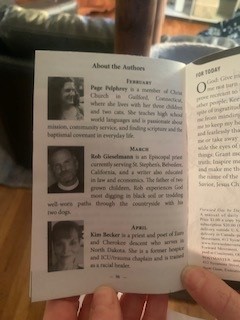
Taking a PAGE from Page Pelphrey’s Devotional

Written By: Caela Collins

Parishioner from Christ Church, Guilford has been selected to write the February entries for Forward Movement

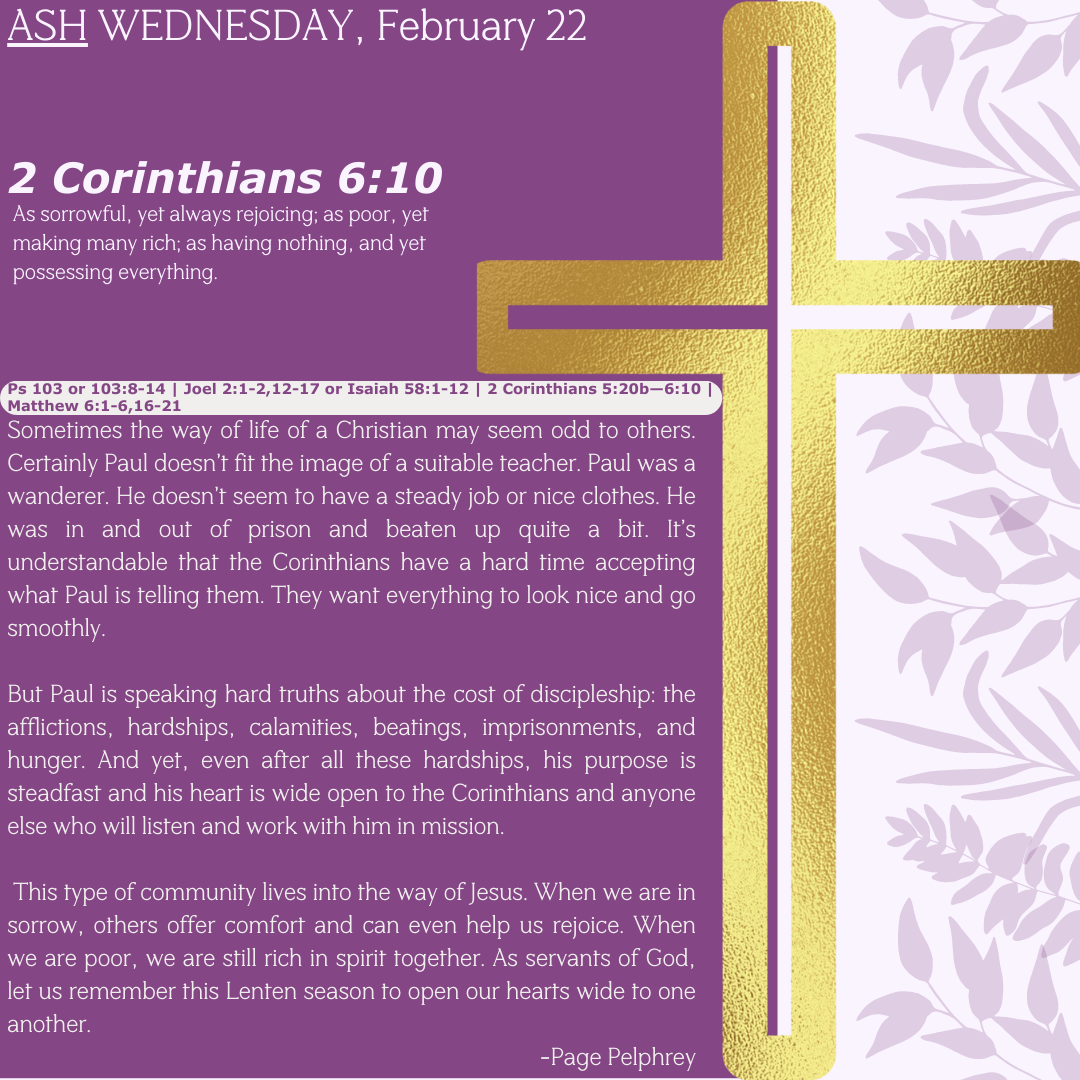
Page Pelphrey, originally from Greensboro, North Carolina, now a parishioner from Christ Church, Guilford, has been selected to write the February entries for Forward Movement, a devotional booklet they publish called Forward Day by Day. Page has a beautiful backstory that led her to take the leap and submit her writings to Forward Movement.

Page is a self-proclaimed Pre-cradle Episcopalian, “All 4 of my grandparents were Episcopalian…they went to the same church. My parents met at church.” She can remember the Forward Day by Day publication as long as she can remember. Her maternal grandmother, also named Page, was an avid reader of the Forward Movement; so much so that it was part of her morning routine, paired with coffee of course!

“My grandfather would bring her coffee… She started her morning with the Forward Day by Day and her Bible.”

Page began reading the publication herself six years before submitting her writing samples. What’s powerful about Page’s story is that her submission was a leap of faith.


“What if they don’t like it?” she thought.

With witting as a hobby and not being formally trained as a writer, the teacher of 25 years, drummed up the courage to submit her devotional writings that she wrote 2-3 years ago. So what gave her that push you’re probably thinking?

“Timing, and you hear that still small voice, that nudge, I think when things don’t go away, when that small voice, when you listen, and it doesn’t go away, and it doesn’t change, it’s time to act on it.”


The inspiration we’d like you to gain from this story is to trust in yourself. God gifted all of us with intuition and speaks to us through our thoughts. You may be feeling hesitant to make a change or embark on a new direction. The path less traveled is a bumpy one but it is so full of promise once you decide to forge it. An unknown path means endless opportunity. If Page decided to leave her devotional writings in her drafts folder, we would never have the opportunity to gain insight from her talent as a now published writer. So Take the Leap, you never know where God is trying to lead you.

“Pray, pray, pray. Follow and listen for that voice. The voice isn’t going to tell you to do anything illegal. Follow your intuition. For me, for me, it’s that still small voice of God. Just let your heart and your gut lead you. You have to get over the fear of rejection, that’s the one thing that stopped me a lot of times. If they say no thankyou, know that something else is coming along.” -Page Pelphrey


Reflection: Puri(fire)

February 2nd is the Feast of The Presentation of Our Lord

Previously, we discussed the conversion of St. Paul, the Apostle who was blind, not just of sight, but blind of heart. After regaining his sight, he was able to look at people he held bias against differently than before. From this story we learned what it means when our faith lacks love. When we hold space for love within our faith, we can see God in others.

This week as we venture into February we reflect on the presentation of baby Jesus, when Mary and Joseph took him to the temple. Luke 2:22 narrates the purification ceremony, required by the law of Moses, that takes place 40 days after a 1st born son is brought into the world.

During this ceremony a burnt offering occurs: a symbolic representation of commitment & surrender to God. A burnt offering, which translates to “ascent” or “stairway” in Hebrew (olah), is a way to atone for sin and show appreciation for the Lord.

Much like the burnt offerings given during the purification ceremony at the temple, this is a time when we offer ourselves to the Lord and surrender to His refining fire; creating in us a pure and clean heart, removing any impurities that blind us, similarly to Saul. There may be periods of discomfort as God purifies us from within to gain clearer sight but let this process encourage us, as it is his overriding commitment to grow us closer to Him.

The Presentation of Our Lord poses a larger theme about ascending to love through God’s light of revelation, Jesus Christ. As our hearts and minds become illuminated by the purifying light of Christ on this day, let it further reveal the significance of acting in harmony as God’s creation, not only within ourselves, but also with others around us. When we activate the spirit of unified love, we enter an expansion that reflects spiritual growth.

When we give unconditional love to our siblings in Christ and compassion to ourselves, it creates a cycle of love that flows back to us, allowing us to truly see the light, God’s grace, and the love of Christ, in everyone. The only way we can truly be siblings in Christ is to love like Christ which will bring about a new way of belonging.

The Season of Refinement is about showing up and making a conscious effort to grow our hearts in the light of Christ and expand our experiences to a boundless loving mindset so we may present ourselves to God in a way that Mary and Joseph presented Jesus in the temple. Consider your community and what needs to be tested by refiners’ fire to look more like God’s Kingdom.


You have a deep knowing that when you pray, meditate, or simply sit in stillness that you open a channel of connection to God, where loving energy and information flows to you and through you.

Meditate on these Affirmations for Balance:

“I am calling in Harmony as God Refines me:”

“Purify my Body.”

“Purify my Heart.”

“Purify my Mind.”

“Purify my Spirit.”

Written By: Caela Collins


Reflection: From Saul to Paul

January 25th is The Feast of the Conversion of Saint Paul.

Paul the Apostle

Before Saint Paul was the Apostle, he was Saul of Tarsus, a persecutor of those who followed and believed in Jesus Christ.

When he set out to find and persecute Christians in Damascus, a bright light blinded him, which was the risen Jesus himself. After that moment his heart was forever changed and he became Paul the Apostle.

Similar to Saint Paul the Apostle, we’ve all experienced having a change of heart, which is part of God’s refining process. For gold to become pure, it must be tested in fire. Much like the bright light of Jesus that blinded Saul, there will be fires sent to test the genuineness of our faith.

This encounter is significant because it reveals to us how Jesus has the power to create in us a sincere change of heart.


We Encourage you to explore The Conversion of Saint Paul and discover ways in which your heart has changed and can still be changed in a season of refinement.

Meditate on these Affirmations for a Renewed Heart and Spirit:
“Burn me Beautiful.”
“Burn me Lovely.”
“Burn me Righteous.”
“Burn me Holy.”

Written By: Caela Collins


Paul the Apostle