Dr. King’s Work Lives on Today

Dr. King’s Work Lives on Today

Offered by the Rev. Whitney Altopp

Join the Rev. Canon Ranjit K. Mathews and the Rev. Whitney Altopp on Feb. 1 at 6 p.m. via Zoom to learn more about The Poor People’s Campaign and the upcoming Mass Poor People’s & Low-Wage Workers’ Assembly and Moral March on Washington. Learn more.

The annual remembrance of Dr. King draws our attention to his call for unity across racial division. This message continues to resonate and inspire us today. However, in honor of him, we would do well to remember his other calls to action. At his death, Dr. King was fighting against what he called the “triplets of evil”– militarism, racism, and economic injustice– a combination which disregards human value. He and others committed themselves to solidarity with the poor of our nation to fight to close the economic gap by addressing the unholy trinity of these three features of American life. The effort was called The Poor People’s Campaign. It could be argued that this is ultimately what got him killed.

The Rev. Dr. William Barber and The Rev. Dr. Liz Theoharis have breathed new life into the Poor People’s Campaign. Beginning in 2018, “from Mother’s Day to the Summer Solstice, poor people and moral witnesses in 40 states committed themselves to a season of direct action to launch the Campaign. What ensued was the most expansive wave of nonviolent civil disobedience in the 21st century United States. More than a series of rallies and actions, a new organism of state-based movements was born. Now, in over 40 states, the groundwork for a mass poor people’s movement is emerging.” [efn_note]Poor People’s Campaign.[/efn_note] This revival of the Poor People’s Campaign came 50 years after Dr. King died working on it.

Then, as now, the Poor People’s Campaign called for attention to:

  • Systemic Racism
  • Poverty and Inequality
  • Ecological Devastation
  • War Economy and Militarism
  • National Morality

When the “triplets of evil”—militarism, racism, and economic injustice— come together, they create an environment of exploitation and disregard. Evil grows up around and through us, seemingly with ease. As the Poor People’s Campaign goes on to say:

“Today, 50 years after Rev. Dr. King and the 1968 Poor People’s Campaign declared that “silence was betrayal,” we are coming together to break the silence and tell the truth about the interlocking evils of systemic racism, poverty, ecological devastation, the war economy and our distorted moral narrative.
The truth is that systemic racism allows us to deny the humanity of others; by denying the humanity of others, we are given permission to exploit or exclude people economically; by exploiting and excluding people economically, we are emboldened to abuse our military powers and, through violence and war, control resources; this quest for the control of resources leads to the potential destruction of our entire ecosystem and everything living in it. And the current moral narrative of our nation both justifies this cycle and distracts us from it.” [efn_note]Poor People’s Campaign.[/efn_note]

In Dr. King’s final book, Where Do We Go From Here? Chaos or Community, published posthumously, we hear his prophetic words for that present moment speak to our present moment.

“We have ancient habits to deal with, vast structures of power, indescribably complicated problems to solve. But unless we abdicate our humanity all together and succumb to fear and impotence in the presence of the weapons we ourselves have created, it is as possible and as urgent to put an end to war and violence between nations as it is to put an end to poverty and racial injustice…I do not minimize the complexity of the problems that need to be faced in achieving disarmament and peace. But I am convinced that we shall not have the will, the courage and the insight to deal with such matters unless in this field we are prepared to undergo a mental and spiritual re-evaluation, a change of focus which will enable us to see that the things that seem most real and powerful are indeed now unreal and have come under sentence of death. We need to make a supreme effort to generate the readiness, indeed the eagerness, to enter into the new world which is now possible, ‘the city which hath foundation, whose Building and Maker is God.’”[efn_note]Martin Luther King, Jr., Where Do We Go From Here? Chaos or Community (Boston: Beacon Press, 1968), 195.[/efn_note]

The Poor People’s Campaign in its current inception helps us have “the will, the courage and the insight to deal with such matters.” The Rev. Canon Ranjit K. Mathews and I are inviting interested persons to a planning meeting on Feb. 1 at 6 p.m. via Zoom, to begin to lay the groundwork for a Connecticut presence at the Mass Poor People’s & Low-Wage Workers’ Assembly and Moral March on Washington on June 18, 2022. Learn more about how you can participate in this planning meeting.

We hope that you’ll be inspired by the closing words of Dr. King’s final book.

“We are now faced with the fact that tomorrow is today. We are confronted with the fierce urgency of now. In this unfolding conundrum of life and history there is such a thing as being too late. Procrastination is still the thief of time. Life often leaves us standing bare, naked and dejected with a lost opportunity. The ‘tide in the affairs of men’ does not remain at the flood; it ebbs. We may cry out desperately for time to pause in her passage, but time is deaf to every plea and rushes on. Over the bleached bones and jumbled residues of numerous civilizations are written the pathetic words: ‘Too late.’ There is an invisible book of life that faithfully records our vigilance or our neglect. ‘The moving finger writes, and having writ moves on…’ We still have a choice today: nonviolent coexistence or violent coannihilation. This may well be mankind’s last chance to choose between chaos or community.” [efn_note] King, 202.[/efn_note]
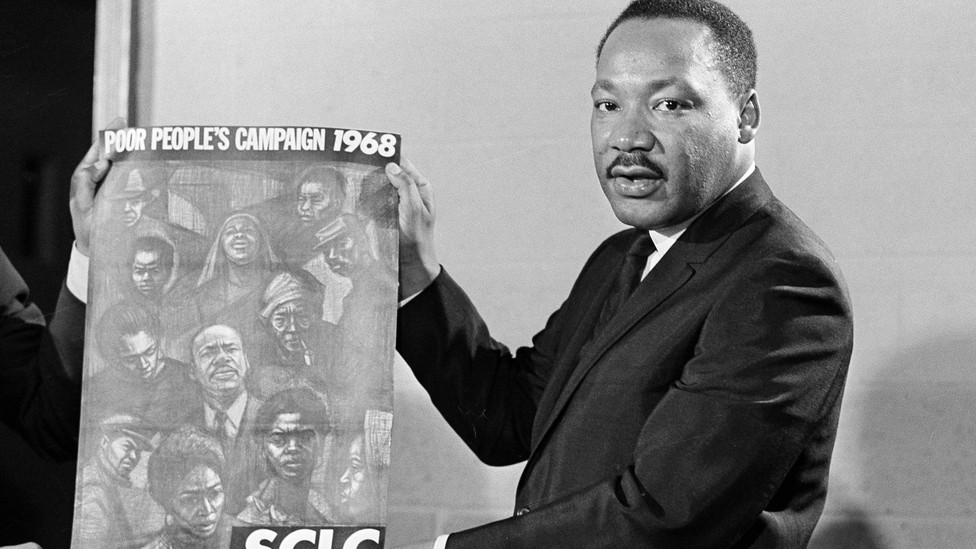
To Be Political

by the Rev. Canon Ranjit K. Mathews

Dr. Martin Luther King Jr. displays the poster to be used during his Poor People’s Campaign on March 4, 1968. (Horace Cort / AP)

One of many teachings that Dr. Martin Luther King, Jr. shared through his life is that as baptized followers of Jesus, our ministry will inevitably be political. He didn’t necessarily name this; but he certainly embodied it.

As Episcopalians, however, it is important that we name politics and that as followers of Jesus, we will have to be political to move into the work that Jesus told us to do, in his name.

Episcopalians find the word “politics” within Church settings difficult because when we hear the word, we think of electoral partisanship. And of course, Churches should never be sites of political partisanship. However, by the very nature of following Jesus and how he called us to live:

The Spirit of the Lord is upon me,
because he has anointed me
to bring good news to the poor.
He has sent me to proclaim release to the captives
and recovery of sight to the blind,
to let the oppressed go free,
to proclaim the year of the Lord’s favor.” (Luke 4:18-19)

we will be political. And like renowned Rabbi Danya Ruttenburg says, “my tradition has policy implications.”

This is but one of the many ways, we can learn from the life of Dr. King.

If we are not able to acknowledge the deeply political dimension of the Gospel, we end up making the Dr. King holiday an idol we worship, celebrating the man, but evading the call to embody the work of Christ.

The reality is the holiday has become a national and even an ecclesial idol, a chance for a majority of the United States and people of faith to talk about a so called “post-racial society, pontificate in a book club about racial justice,” but stopping from taking the next collective step forward as a society to challenge systemic injustice. The holiday has become an opiate to embodied justice work.

Jesus never called us to worship him; but to follow him. It is always time to talk, ponder, and stretch our own moral imagination to the life of Dr. King; but we should not stop there. Our communal reality calls us to embody, to live a life that is radiant with justice. What we profess on a Sunday morning needs to live on, on a Monday.

In what ways can you take another step forward in embodying the Gospel? In a culture of silence, speak the Truth in Love. Do some research on the Poor People’s Campaign. There are endless opportunities and I invite you to take the next right step.

#AdventWord Reflections from the Fourth Week of Advent

#AdventWord may be over, and we didn’t want you to miss the great reflections from the fourth week of Advent shared on ECCT’s Facebook and Instagram. #AdventWord #GodisStillSpeaking


#feed

December 20


#generations

December 21


#magnify

December 22


#flock

December 23


#greeting

December 24


#child

December 25

More from ECCT Stories

#AdventWord Reflections from the Third Week of Advent

As in year’s past, ECCT is participating in #AdventWord. Each day during Advent, we post the daily #AdventWord on our FacebookTwitter, and Instagram feed. We welcome and encourage everyone to join in commenting in response to day’s post with a word, thought, image, poem, prayer, or whatever the Spirit prompts in you each day. Below you will find the comments posted on each day’s word on our Facebook and Instagram feed. We welcome you to read, look, listen, and reflect on our first week walking through Advent together.


#share

December 13


#exult

December 14


#stir

December 15


#gladness

December 16


#bountiful

December 17


#sing

December 18


#blessed

December 19

Learn more about the global #AdventWord community.

More from ECCT Stories

#AdventWord Reflections from the Second Week of Advent

As in year’s past, ECCT is participating in #AdventWord. Each day during Advent, we post the daily #AdventWord on our FacebookTwitter, and Instagram feed. We welcome and encourage everyone to join in commenting in response to day’s post with a word, thought, image, poem, prayer, or whatever the Spirit prompts in you each day. Below you will find the comments posted on each day’s word on our Facebook and Instagram feed. We welcome you to read, look, listen, and reflect on our first week walking through Advent together.


#everlasting

December 6


#offering

December 7


#messenger

December 8


#splendor

December 9


#repent

December 10


#compassion

December 11


#expectation

December 12

Learn more about the global #AdventWord community.

More from ECCT Stories

#AdventWord Reflections from the First Week of Advent

As in year’s past, ECCT is participating in #AdventWord. Each day during Advent, we post the daily #AdventWord on our FacebookTwitter, and Instagram feed. We welcome and encourage everyone to join in commenting in response to day’s post with a word, thought, image, poem, prayer, or whatever the Spirit prompts in you each day. Below you will find the comments posted on each day’s word on our Facebook feed. We welcome you to read, look, listen, and reflect on our first week walking through Advent together.


#promise

November 28


#strength

November 29


#soul

November 30


#path

December 1


#justice

December 2


#fulfill

December 3


#heart

December 4


#praise

December 5

Learn more about the global #AdventWord community.

More from ECCT Stories

Pausing to Give Thanks

Shared by the Rt. Rev. Ian T. Douglas, Bishop Diocesan.

Next week, on December 1, I will begin a three-month sabbatical. The root word for sabbatical is sabbath: a time set apart from everyday roles and responsibilities to be with God – a time to pause, rest, and reflect. All clergy serving in full-time parish or diocesan ministry in Connecticut, including your bishops, are blessed with the privilege of a three month sabbatical after five years of continuous service. Since my last sabbatical was July-September 2016, I had hoped to begin my second and final sabbatical last summer following my call for the election of the XVI Bishop Diocesan and a full year before I depart as your bishop on October 8, 2022. Because of the surge of the COVID-19 Delta Variant in the late summer I chose to postpone my sabbatical until a more suitable time.

Five years ago my sabbatical included the study of non-profit management at Harvard Business School and my first ever pilgrimage to the Holy Land. This upcoming sabbatical will be much more quotidian and less-glamorous. Often bishops are too busy to put their affairs in order before retiring; and yet it is important for diocesan archives that a bishop’s papers are well kept. Because of my commitment to leaving well and my appreciation for archives, I plan to use my upcoming sabbatical to go through and organize my papers, correspondence, files, emails, and books that have accumulated during the twelve years I have been bishop in preparation for collection in the ECCT archives. This archival work, however, will be much more than an administrative exercise. I have been invited by my spiritual director to pause with each file, letter, and email and give thanks to God for the blessing of each and every companion in Christ with whom I have shared in God’s mission of restoration and reconciliation. I very much look forward to such.

In order to live fully into this sabbath time of pausing and giving thanks, I will not be responding to incoming emails, phone calls, or correspondence; nor will I participate in Sunday parish visitations or diocesan meetings including our Wednesday morning Zoom calls with wardens, clergy, Region Leadership Teams, and ECCT staff. There will, however, be a few exceptions as I will continue my work with current clergy discipline cases and pressing property development plans for real estate held by the Missionary Society of ECCT. While I am away, episcopal oversight for ECCT will be in the most able and caring hands of Bishop Laura Ahrens. I thank God for Laura’s ever-sustaining collegiality, support, and friendship.

I close with the words of the Apostle Paul which sum up my feelings for all in ECCT as I go on sabbatical: “We always give thanks to God for all of you and mention you in our prayers, constantly remembering before our God and Father your work of faith and labor of love and steadfastness of hope in our Lord Jesus Christ.” (1 Thessalonians 1:2-3)

ECCT Stories: Sharing Our Story

Welcome to the new home of ECCT Stories on our newly updated website!

As you’ve likely discovered by now, there are many new features included in this website. And there’s one you may not have stumbled upon just yet: Sharing Our Story.

The Sharing Our Story pages are all about “Who We Are”—Our Past, Our Present, and Our Future.

We hope you’ll take a few moments and explore “Our Past,” and maybe discover something you didn’t know before.

You’re in “Our Present” right now! Our stories, blogs, and vlogs are our present, telling the stories of our life together and where we see and experience God moving amongst us.

And while both of these pages, “Our Past” and “Our Present” are, and will continue to, share “our story” as followers of Christ in the Episcopal Way in Connecticut, there is one other page you may be wondering about—”Our Future”.

“Our Future” is about all of us. It is an interactive space where we share our hopes and aspirations for our diocese as followers of Jesus in the Episcopal Church in Connecticut. “Our Future” invites us to share, listen, watch, and pray with one another for the future we dream of. And then, to step forward boldly in the name of Christ to bring “Our Future” into “Our Present.”

So stop by, watch, listen, read, and pray…and then share your dream for “Our Future.”