Proud to Support LGBTQIA+ Pride

Proud to Support LGBTQIA+ Pride

This blog post was written by the Rev. Helena Martin, St. Paul’s, Southington. Originally posted June 16, 2021.

The Rev. Helena Martin celebrates a special LGBTQIA+ outdoor Eucharist

My eyes scanned the faces of the forty or so people gathered, all looking up at the flag pole. With the help of Boy Scout Troop 45, St. Paul’s Episcopal Church in Southington had just raised its first LGBTQIA+ Pride flag.

It flapped freely in the wind, right under our American flag on our front lawn. A few tears pricked my eyes at the sight. I’d been looking at this same flag draped over my couch all week, but flying in the wind was different. It was even better than I’d hoped.

For generations, the church has rejected people based on gender identity or sexuality. In fact, fear and rejection continue to pour out of certain churches today. Still, there are many Christians who believe God made us—all of us—in God’s image (Genesis 1:27) and knit us together in the womb (Psalm 139:13). For this latter group, we have to be just as loud about God’s abundant love as others are about their hatred.

The Pride events we participated in as a parish were overwhelmingly fun. After the flag raising, we attended the Pride Family Fun Day at YMCA Camp Sloper, which bustled with activity despite the rain and 50-degree temperatures. I and my colleague, Pastor Laura Kistharddt, had the pleasure of introducing Ms. Robin Fierce for Drag Queen Story Hour. And, as a recently ordained priest, I had the joy of presiding at the table during our first ever Pride Sunday Worship.

Our church office has been getting phone calls complaining about the flag hung outside our building—usually anonymous, with varying levels of kindness or nastiness. Whatever grief we’ve received, the Southington Pride organization has been far more beleaguered. And yet, the outpouring of love and support from all quarters of the Southington community has been unambiguous: our town loves its LGBTQIA+ residents, especially the children.

Pride-themed rainbow flowers at St. Paul’s Southington

It’s like Mary prophesies at the beginning of the Gospel of Luke, when she finds out she’s pregnant with Jesus:

[God] has shown strength with his arm;
he has scattered the proud in the thoughts of their hearts.
He has brought down the powerful from their thrones,
and lifted up the lowly;
he has filled the hungry with good things,
and sent the rich away empty. 
(Luke 1:51–53)

Mary is telling us where to cast our gaze to find God, and it’s not to the places of wealth and power. God has a special kind of love for the people whom society casts out. In our society, unfortunately, that still includes LGBTQIA+ people.
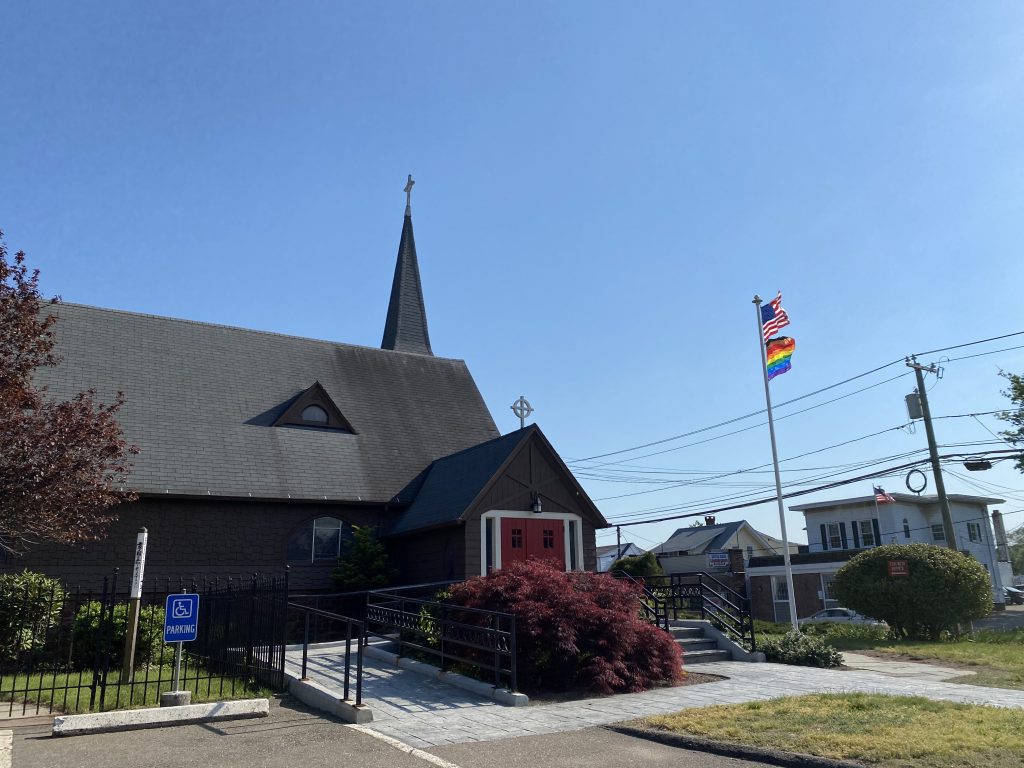
The Philadelphia Pride Flag flies over St. Paul’s, Southington.

Putting up the Pride flag was not a way for our parish to check a box or prove anything. Rather, it was a way for us to express who we already are—and to make it clear our welcome really does apply to everyone. Perhaps most importantly, the flag is an indication of our ongoing commitment to ensuring we really are embodying God’s love to every single person who walks in our door.

I didn’t know how many people to expect on that first Friday afternoon. But there, spread across our small lawn, were people of all sexualities and gender identities from St. Paul’s and around town; tearing up, grinning, and praying together. And Jesus’ presence with us was unmistakable.

Other archived ECCT Stories can be found here.

Remembering the Rev. Lee McGee Street

The Rev. Eleanor Lee McGee Street was a trailblazer in the Episcopal Church. Her unauthorized ordination to the priesthood as part of the "Washington Four" in 1975 helped open the doors to female clergy across the Episcopal Church. In memory of Lee and her incredible contributions to the church, we asked female clergy in ECCT to share their memories of her...

Reflections from the Reception Desk

I volunteer at the New London Homeless Hospitality Resource Center on 727 Bank Street in New London. I serve as a receptionist at the center and am able to give witness to those experiencing poverty – the poor walk through our door. I’ve looked into their eyes; heard their voices; and listened to their pleas.

Holy Week.

I can do all things through him who strengthens me. (Philippians 4:13) Holy Week is upon us. I don’t know how you all do it. But I’m about to find out.

Poverty As a Mystery to Be Entered Into

This blog post has been submitted on behalf of the ECCT Poor People’s Campaign Working Group. Learn more about The Poor People’s Campaign and the upcoming Mass Poor People’s & Low-Wage Workers’ Assembly and Moral March on Washington June 18.

Offered by the Rev. Deacon Ronald Steed

I work at the New London Homeless Hospitality Center, an emergency shelter and housing agency, alongside neighbors who are experiencing homelessness and poverty. I used to think that poverty was a problem to be solved and I found that my ego could not help but to get thoroughly immersed in it.

As a “Problem”, poverty was something I could walk around and consider at a distance… it was a challenge… one my mind was eager to solve. Over time, I felt frustration, anger, and rage at the problem, its intractability, its injustice. And… I began to regard the people experiencing this problem as a problem themselves. My language changed: “you should do this” or “you need to do that”. Poverty as a problem-to-be-solved became de-humanizing to them… and to me.

Now, I see poverty more as a spiritual force in the world and a mystery to be entered into… more as a work of the heart rather than the head. And since it IS a mystery, I have to enter into it WITH the person who is experiencing it. To see it as THEY see it… to respond to it in the ways that THEY want to respond. I have to let go of my solutions for them… let go of my “expertise”… let go of outcomes. Rather, to scatter seeds… to be a midwife.

There are completely different emotions that come with heart-work: empathy, heart-break, hope, contemplation… joy. These are some of the cross-shaped emotions of coming alongside. I invite the Spirit into the heart-space… ask her to be with us… invite Jesus in as well, asking for his healing power to be brought to bear.

One of our Community Navigators was telling me about her heart-break as a person described the INDIGNITY of poverty… of constantly having to ask for help, and then having to ask again, over and over. She has begun to see her work, not so much as finding a house and employment and healthcare for them, but as restoring their dignity, as an act of resistance against a spiritual force. There is a mystery in that to be entered into…

My name is Marc, and I prefer Lent.

The Rev. Marc G. Eames, Priest-in-Charge, St. John’s, Vernon

It seems a strange thing to admit, rather like confessing to a class of sixth graders that you enjoy homework, but Lent is my favorite liturgical season.  Other seasons are beloved with good reason, and many of us tell stories of Easter egg hunts, the singing of Christmas Carols, or even visiting diocesan camps or seaside chapels during summer’s ordinary time. I do love Advent, but it is a season continually squashed by the behemoth of Christmas.  Christmas is full of joy, but it also carries a lot of materialistic baggage and gives free rein to the antics of a patron saint, the legalistic troll known as the Elf on the Shelf.  I love Easter Sunday, one of my favorite days of the year, but I will never forget the disappointment I felt during my curacy seeing a nearly empty church the following Sunday.  Easter, as a season, never seems to live up to its promise. 

So, despite its lack of flash, I appreciate the depth of Lent. Lent is humble and unassuming.  It preaches simplicity to a culture steeped in excess.  While I exult in joy, and I was spiritually raised with the great Anglo-Catholic lesson that “anything worth doing is worth overdoing”, Lent advises restraint.  The season guides us to choose less instead of more and counsels teaching through silence over erudite elocution.  The truth is that I need Lent.  Lenten Sundays combine the message of preparing for Easter while celebrating the reality of Easter in the Eucharist.  This practice suits our time.  We live in a period that is already and not yet, the kept promises of God surrounding and uplifting us while other hopes remain unfulfilled.  

I confess to needing the seriousness of Lent, focusing on something deep and true to avoid becoming a thoughtless dilettante of the liturgical world.  I need to reflect on those old commandments that I have read thousands of times and consider:  What idols have I exchanged for the ancient Asherah and Baal? 

St. John’s in Vernon, my new call, uses Lent as its primary Stewardship season.  I have never experienced this arrangement before, but it has challenged me to devote more thought and prayer to how I am spending my money.  What charities am I supporting, and what products am I buying?  Do they align with the values that I find in scripture and teach in my parish?  Can I find a simpler, more local option, or find a way of reusing something or going without?

Lent is challenging in its simplicity. It calls for focus and reflection.  It demands something of me, and it has become my favorite season.  

The Importance of Home

The Rev. Shancia Jarrett was recently featured in an article in the New Haven Independent featuring some of the important work she is doing as Affordable Housing Commission Consultant in New Haven. The article focused on Shancia’s work in developing a Below-Market Rental registry, and highlighted her focus on the need for affordable housing in Connecticut.

We wondered how Shancia’s experiences as a follower of Christ and a priest in The Episcopal Church have influenced and impacted her work in affordable housing…so we asked her.

How did you get started in this work?

During my latter years of seminary, I was intrigued by Aldo Leopard’s philosophy on Land Ethics and the theology of Creation. Through this understanding, I focused on four theological truths: (1) God created the Earth (land) prior to humanity (2) God bestowed blessings of goodness on Creation in its entirety and entrusted and equipped humanity with the virtuous wisdom to care for the Earth, (3) God is just and loving, (4) Out of Divine love each person is a bestowed the goodness of life and situated by the Divine in a place and that place for me embodied a home. With the gifts of knowledge, wisdom, and of technology the idea of home has significantly evolved with human development through disciplines of architecture and sustainability.

Ironically, theological truths were further stimulated within economics courses where I developed educational resources on the disparate impact and the monetary and public costs of lead poisoning awareness efforts among children and youth development.  As a result of this project, I was invited by the city of New Haven to present my research and a proposed petition for the  Environmental Protection Agency. To my surprise, within this meeting, I was hired to convene New Haven’s Affordable Housing Commission. I never imagined that developers and versed housing advocates would validate and invest in the recommendations of a Divinity student. 

Where have you found joy in this work?

My engagement with housing extends beyond norms of typical work. Similarly to contemporary theologians, my engagement revolves on a “theology of work that does not begin with our understanding of what God wants us to do or even how to do it. It begins with the God who has revealed the Divine in Creation and Redemption, and who shows us how to follow Christ by being formed in the Divine character.” For me, the Divine character of God is love. I love what I am doing and the people with whom I collaborate to promote awareness.

Also, in light of this quotation, I acknowledge that many are on a quest to find their vocations, but housing found me. Somehow, my passion for Land Ethics and Creation revealed and prepared me to engage housing disparities within morally ethical and economic models of community development. As I reflect on the genesis of my career in housing, publications, and facilitation skills, I am overwhelmed with joy to efficiently collaborate with the commissioners whose expertise range from legal scholarship, development, housing advocacy, community members, formerly homeless individuals, parents, and activism. From these experiences and professional transitions, my colleagues and Commissioners have shaped my formation and challenged me to become an informed voice on housing.

What has broken your heart?

The challenges of uninformed opposition to affordable housing are disheartening. For instance, one of the greatest misconceptions is the belief that it is restricted to low income families, however, that is a dense interpretation of housing economics. Low-income families are indeed vulnerable to housing burdens; however, the government offers significant housing subsidies to assist such families. On the other hand, non-subsidized households such as those with an annual income of greater than $73,000 and non-disabled senior citizens have significant housing burdens and exhaust more than 50% of their income to compensate for the housing market’s increased rental and home purchasing rates.   

How do you see this work as participating in God’s Mission in Connecticut?

I strongly affirm that the church has a commitment to living out the ministries of the Gospel while administering its sacraments. For instance, during the first century, Early Christians worshiped in the homes of patrons and Apostles. Historically, the priesthood and my theological education is the spiritual and transformative home or the place where God situated me to participate in housing ministry. Without the theological training and support of the ECCT, I would not have had the versatility to become a bi-vocational priest and to share my ministries. It is an honor for ECCT to recognize and share my advocacy efforts.

What is one thing people could do to participate in this work?

One thing people could do to participate is to remember and to listen to God’s loving Divine character and the importance of having a home, a place to live, and how it shapes our understanding of the environment and development as an individual, a church, and a society.  It may sound harsh, but I do not encourage churches to naively advocate for affordable housing. Instead, I invite them to prayerfully discern its need and their willingness to listen to the testimonies of housing vulnerable populations.  Thus, allowing their advocacy to develop sustainability, and to establish internal support, and community partnerships. Churches and individuals interested in exploring affordable housing can contact me at sjarrett@edcnewhaven.com

A Whole Bunch of Thoughts That Took 5 Minutes to Think

A Whole Bunch of Thoughts That Took 5 Minutes to Think

The Rev. Matt Handi, St. Luke’s, South Glastonbury

It’s 4 am. Too soon to be awake, too late to fall back asleep; I keep fading in and out. I went to bed with tomorrow on my mind and now tomorrow is today, first day jitters. Finally, at around 6 am I rise and head to the shower, my imagined leap out of bed is measured by a lack of sleep and the anxiousness I feel about starting a new call, my first call, a new priest in a new church.

I drive the half hour from home to Glastonbury, the morning light brightens the edges of a thin cloud with a wonderful array of oranges and yellows, a welcomed display as I head northeast on 84.

I arrive at the church. I place the key in the lock.

It doesn’t work.

I try shaking it and pushing my shoulder to the door and shaking the handle while turning the key just so and! Nothing.

First day. I’m stuck outside the church and it’s early yet and the key just won’t budge. This is frustrating.

While fiddling with the lock, my mind wanders. Frustrated thoughts mix with a rehash of the years, an appreciation of time past.

Today is the dream fulfilled. A faint call that grew louder over time, over years; I thought the act of walking into a small parish church after many years away was me answering that call. But the urge for more persisted, the urge to do more lingered. I joined the vestry, I became the Treasurer, I taught kids in J2A, I even started working for the church and still the call persisted. Impossible.

I try bracing my hip against the door, relieving any pressure on the lock that might be holding it back. One more time into the breach, I try to turn the key and! Nothing.

While fiddling some more, I realize I am standing on the shoulders of giants. Commission folks who gave me their time, their help, sat with me in conference room conversations and library chats, their calm touch and their listening ears provided support. Committee folks who gave up Saturdays to listen to my nervous rationalizations around my call to be a priest. Bishop folks who were so dedicated to guiding me through, whose words and letters and lunches were a gift of reassurance and correction.

So, I’m thinking if I press my knee against the door and my hand just above the handle while pushing on the door at the same time, I’m pretty sure I’ll be able to turn the key. I do so and! Nothing.

Frustration grumbles. It’s my first day and I can’t even get into the door. I’m not even sure I belong here. What about those others? Those giants? The ones who walk into the room and you think, wow! That woman is a priest! And she carries herself with such confidence and owns the room with knowledge and care, the collar is optional. How do I measure up? And doubt, well. Let’s put away doubt.

I am out of ideas. Until. Well, I’ve been standing outside this locked door for not too long now, there are other doors. The undercroft! I can get in through the basement! And so, I head around the corner.

I look once more towards the sky; the darker indigos of early dawn are giving way to the brighter blues of daylight. The colors though, remind me of a different sky in a different place.

The sky recalls my childhood yesterdays and the brook that flowed at the bottom of my street. I would build dams down there, ingenious constructions of the 10-year-old kind. Kid things that paused the flow but stopped nothing, those dams lasted no longer than Thomas doubted.

Hearing my mother’s voice calling into the dusk it was time to head back. I walked my bike up the hill from the brook. I saw home. Bright yellow lamplight shown through the bay window of our tiny raised ranch, white with black shutters and a red door. Walking up the driveway, I dropped the bike near the shed. I walked inside.

“Hey Mom”, I said. “I’m home. I heard you calling.”

I reach the undercroft door; the key turns and the door opens.

I step inside.

There are thresholds to be crossed.

The world is a fragile place.

The world is a fragile place.

The Rev. Dr. Anita Schell, St. Ann’s, Old Lyme

Years ago while team teaching a course at Southern Vermont College in Bennington VT, I was struck by what one of the professors said about the critical role our imaginations play in our life as people of faith. In the Tuesday evening Comparative Religions course, my team teacher invited us to look at the imaginary games we played at ages 3 and 4. These games would give us clues as to the pursuits of our later adult years. What games did you play that highlighted your dreams? It’s such a great question!

And, our imaginations are more than pondering our own dreams. Our imaginations can help us to envision how others live, and by imagining, can increase in us greater compassion and the courage to work for change in making a better, just world for all, no matter what the consequences to our comfort levels.  Such imagining a better world for all and striving to create concrete steps toward that goal were in evidence last fall at the 26th Conference of the Parties to the United Nations Framework Convention on Climate Change, known as “COP26.”

24 lay and clergy delegates from the Episcopal Church representing Presiding Bishop Michael Curry and The Episcopal Church  were led by Bishop Marc Andrus of California. Part of the delegates’ mission was to learn about the state of the climate crisis and efforts to address it, and to bring what they learned back to the wider church.

During COP26, the Episcopal delegates (as well as their Anglican counterparts) communicated their priorities to U.N. member states, participated in meetings and discussion forums, shared updates on social media and hosted events, including a “Liturgy for Planetary Crisis” and morning and evening prayer services. Episcopalians participated virtually from the United States, Europe and South America. Good intentions and work notwithstanding, advocacy to reduce the negative impacts of climate crisis is not felt equally among communities in the United States and around the globe. Fragility is not a uniform experience. As our   Presiding Bishop Curry said in a Nov. 12 ABC News interview., “The most impacted [are] Indigenous peoples, people who are tied to the land, poor people.”  And “We will see more mass migrations of people looking for food. … These will have an impact on the poorest of the poor.”

Added to the reality of such injustice is the Covid-19 pandemic. As the Archbishop of Canterbury Justin Welby wrote during COP26,

“The Covid-19 pandemic has forced the world to look at how we have been living and operating, when so much of what was considered ‘normal’ was not possible. We have been confronted by our behaviour: by our sin; our greed; our human fragility; our exploitation of the environment and encroachment on the natural world. For many this uncertainty is new. But many more around the world have been living with uncertainty for decades as the grim, real and present consequence of climate change.”

The Creation Care resolution #3 adopted at ECCT’s 2021 Convention specifically addressees this moral crisis with concrete action steps for every single one of us. As with addressing Covid-19 and racism, these resolves are intentional and mindful practices we as people of faith in CT can take in our Christian discipleship. While we know these unjust realities exist, concrete data received from the resolve steps of this resolution will enable us to better serve and support every community of our beloved ECCT, especially and particularly those for whom fragility is exacerbated by these multiple crises.

The world is a fragile place.  It has always been so. How can we confess where we have contributed to this fragility and turn to repair brokenness especially for those beings for whom fragility has always been a way of life?